Keeping Hospitality Comfort Intact Throughout the Enhancement Works

Capitalising on Singapore’s 4.4 Million Tourism Increase Through Strategic Upgrades

Singapore's projected full-year tourism receipts of S$32.5 billion have incentivised hospitality owners to invest in upgrades to maintain market competitiveness. Despite the clear market outlook, executing an interior overhaul may impact ongoing guest experience.
United Engineers Limited engaged us to resolve these exact operational complexities at Park Avenue Rochester through strategic Asset Enhancement Initiatives (AEI). Built in 2011, Park Avenue Rochester is a prominent mixed-use development located in the one-north precinct, integrating a 3-story retail mall with 351 accommodation units split between contemporary hotel rooms and 121 serviced apartments.
Partnering with Pod Design Studio, Express21 and CCL Chartered Surveyors, we took on the responsibility of managing this fast-track infrastructure and suite modernisation, to achieve the necessary Building and Construction Authority (BCA) Green Mark standards in energy efficiency without compromising ongoing hotel operations.
We begin by outlining the upgrades needed to improve the property's indoor environment, then explore the staging and site-containment strategies that enabled us to deliver these engineering works while keeping the hotel open to guests. Subsequently, we examine the material selections and environmental mitigation policies used to control the surrounding atmosphere during construction. Finally, we look at how these elements culminated in a full-scale aesthetic upgrade across the suites.
Elevating Indoor Air Quality and Resolving Stale Odour Concerns

When hospitality assets age, physical deterioration impacts operational performance. At Park Avenue Rochester, our team worked closely with client’s team to address their concerns regarding stagnant air that compromised the guest experience across serviced suites. To blend modern luxury with long-term guest comfort, we executed a structural solution that targeted the root cause of the ventilation issues.
We focused on upgrading the aging ACMV systems serving all 121 guest rooms alongside corridor zones. Our site team demolished the outdated air-conditioning units and stripped out the ventilation ductwork to permanently eliminate the damp, stagnant air pockets.
To deliver hotel odour control solutions operators can rely on, we worked alongside mechanical engineers and specialist air-side contractors to install new Fan Coil Units (FCUs) and advanced air-distribution duct systems. The upgrade was paired with improved smoke extraction, ventilation provisions, and carbon monoxide detection upgrades, all integrated into the building’s existing structure.
Sequencing Phases to Minimise Closures in a Live Hotel
Executing a live hotel renovation requires a balance between intensive engineering and undisturbed guest operations. For the 20-week program at Park Avenue Rochester, our team engineered a site management strategy that allowed the property to remain partially operational throughout construction.
Phased scheduling formed the foundation of our operational approach. The work was divided into two major phases covering different floor zones, which were further broken down into sub-phases to limit the scope of closures. However, for the most disruptive tasks, full-hotel shutdowns were scheduled in agreement with the hotel operator to protect the guest experience.
To contain contaminants, we established physical segregation between active work zones and guest areas. We implemented negative air pressure systems using temporary extraction fans within the construction zones. This setup expelled any smells from painting or adhesives away from guest areas.
Material Specification and Site Controls for Minimum Environmental Impact

Maintaining a premium guest experience during a hospitality fit-out requires operational discipline that extends beyond physical barriers. Managing noise was our first operational priority, which we achieved by enforcing strict time windows that restricted disruptive activities like drilling or heavy demolition to midday off-peak hours when guest occupancy was lowest.
Beyond noise management, achieving the BCA Green Mark standards required oversight of every material entering the project footprint. Our procurement strategy demanded the use of low-VOC (Volatile Organic Compound) materials, ensuring that all paints, sealants, and construction adhesives complied with ecological and health benchmarks. By avoiding high-emission products, we eliminated the chemical off-gassing that compromised commercial environments during ongoing interior refurbishments. To protect guests from airborne irritants, our site team paired these strict material selections with active measures, including odour-neutralising agents and filtration system throughout active construction zones, to minimise any impact from smells.
Transforming 121 Serviced Suite Rooms with High Specification Finishes

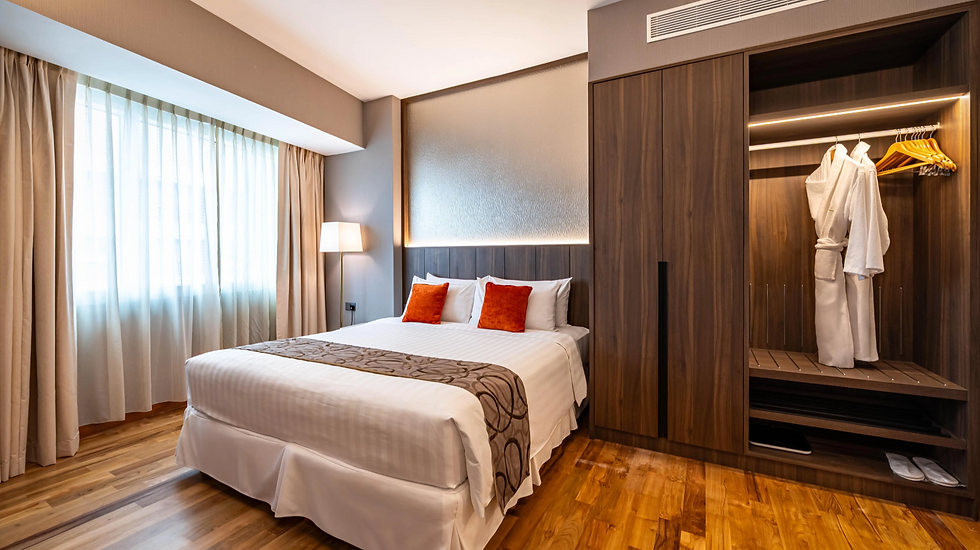
The final phase of our work focused on an aesthetic transformation of the guest experience. We executed a full interior revamp across all 121 suites, striking a balance between sustainable materials and the elevated design vision established by Pod Design Studio. Our craftspeople stripped out the existing finishes to build modern environments defined by bespoke joinery and premium details.
The visual identity of each suite relies on our built-in furniture and wall finishes. We installed new partitions, ceilings, doors, and carpentry, alongside bespoke joinery installations such as wardrobes and bedhead feature walls. This new infrastructure is balanced by luxurious wallpaper and feature panelling, establishing a clean backdrop across the refreshed accommodation.
The project highlights the value of an integrated delivery model, where mechanical upgrades and sustainability metrics reinforce high-specification interior design. Central to this success was a commitment to Health, Safety, and Environment (HSE) standards. For our workers, TCG maintained rigorous site discipline to complete the 20-week program with zero major incidents. Simultaneously, through the careful deployment of negative air pressure systems, strict off-peak noise control, and low-VOC materials, we successfully isolated the construction footprint, ensuring the live hotel environment remained safe, and undisturbed throughout the transformation.
By aligning our construction methodologies with environmental standards, we ensured that every finish was supported by odour-free, and high-efficiency ventilation systems that protect the property's long-term operational health. Park Avenue Rochester is proof that even under complex, live-site conditions, it is possible to balance building standards with an uncompromised guest experience. We are ready to deliver this level of precision and care again with partners who value the difference good building makes.
Comments